Arora Group vs Heathrow Airport Limited: Key Differences Between Their Expansion Schemes

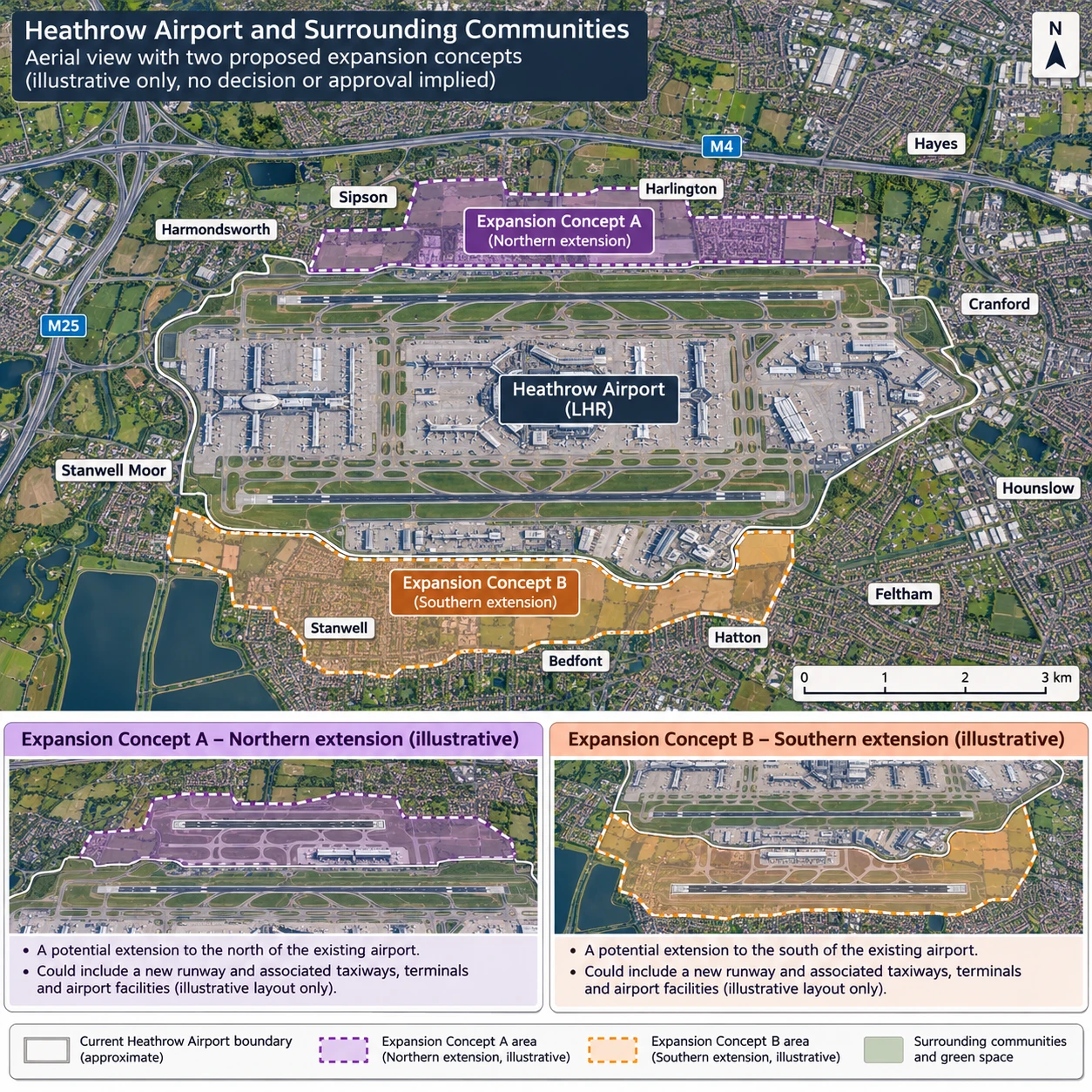
The Arora Group and Heathrow Airport Limited (HAL) have put forward competing approaches to Heathrow expansion. Their proposals matter to nearby communities because choices about airport layout and supporting infrastructure can affect land use, flight operations, road traffic, noise and air quality.
At this stage, a responsible comparison must separate what each organisation has publicly proposed from what has been assessed or decided. Neither a proposal nor contact with the Planning Inspectorate means a scheme has planning approval. For Stanwell Moor residents, the practical question is how each design would be assessed and what evidence will be available to compare them.
Why are there competing Heathrow expansion schemes?
There are competing Heathrow expansion schemes because the Arora Group and Heathrow Airport Limited have advanced different concepts for increasing airport capacity. Comparing them can help communities understand what is proposed, which effects may differ, and what information remains outstanding.
Heathrow expansion involves more than adding airport capacity. A scheme may require changes to airport land, runways or terminals, surface transport, utilities and construction arrangements. Those choices can have different consequences for nearby places, including Stanwell Moor, even when proposals share the broad aim of accommodating more passengers or flights.
Proposal is not approval. Plans can change during design, consultation and examination. Their environmental effects also depend on details such as flight paths, operating assumptions, construction phasing and the location of associated infrastructure. A headline drawing or an organisation’s description cannot establish the likely effect on a particular street or household.
Residents should therefore compare like with like: the latest version of each proposal, its defined boundary, the infrastructure included, and the assumptions behind its forecasts. If one proposal has more published detail than another, that is a difference in the available evidence, not proof that its impacts will be smaller.
What does each scheme propose?
The Arora Group’s scheme and HAL’s proposal are competing concepts, but the detail of each should be checked against the organisations’ current published material. Without a verified, matched set of plans, specific claims about exact footprints or infrastructure should not be treated as settled facts.
HAL is the airport operator and has set out its own approach to Heathrow’s future development. The Arora Group has promoted an alternative expansion scheme. The meaningful comparison is not simply which organisation supports expansion; it is what each design includes and how each says it would deliver additional capacity.
For each proposal, look for the same basic information:
- Site and footprint: which land is required, where the boundary sits and whether nearby communities or properties are affected.
- Airport infrastructure: what is proposed for runways, terminals, taxiways and other facilities, as described in the latest plans.
- Surface access and utilities: whether roads, rail links, public transport, energy, water or drainage changes are included.
- Delivery assumptions: the proposed construction sequence, programme, funding approach and responsibilities for implementation.
- Environmental evidence: the methods and assumptions used to assess noise, air quality, traffic and other effects.
Check publication dates and document versions before relying on a comparison. Early concepts often lack the detail needed for a reliable impact assessment, and later documents may refine boundaries or operating assumptions.
Key differences at a glance
The key differences should be judged across scope, location, infrastructure, delivery and environmental evidence. A side-by-side table is useful, but it should distinguish verified proposal details from information that has not yet been confirmed.
| Comparison point | Arora Group | Heathrow Airport Limited |
|---|---|---|
| Overall approach | An alternative expansion concept promoted by the Arora Group; consult its latest plans for the defined scope. | HAL’s own proposal for Heathrow expansion; consult the operator’s latest plans for the defined scope. |
| Footprint and land requirements | Verify against current maps and land plans before drawing conclusions about affected areas. | Verify against current maps and land plans before drawing conclusions about affected areas. |
| Infrastructure included | Compare the published runway, terminal, access and utility details with HAL’s documents. | Compare the published runway, terminal, access and utility details with the Arora Group’s documents. |
| Noise and air-quality evidence | Potential effects require assessment using stated assumptions and suitable local data. | Potential effects require assessment using stated assumptions and suitable local data. |
| Planning status | A proposal is not a planning decision or permission. | A proposal is not a planning decision or permission. |
This table does not claim that the proposals are identical. It shows where residents should seek comparable evidence rather than infer differences from promotional summaries. If a plan provides a precise boundary or technical assessment, record the document title, publication date and page so the comparison remains traceable.
The most useful comparison is evidence-led: compare the same impact, time period and scenario for both schemes. For example, noise figures based on different flight assumptions cannot be compared fairly without understanding those assumptions.
What could the schemes mean for Stanwell Moor?
Either Heathrow expansion proposal could raise questions about noise and air quality in Stanwell Moor, but the scale and direction of any effect cannot be established without detailed designs and environmental assessment. Potential impacts must not be presented as confirmed outcomes.
Noise assessment should explain how aircraft operations, flight paths, ground activity and construction could affect the area. Relevant evidence may include noise contours, the number of people exposed at different levels, changes in night-time noise and the assumptions used for future flights. A contour map is a useful starting point, but it does not describe every household’s experience or capture all sources of sound.
Air-quality analysis should identify emissions sources and assess concentrations at suitable locations. These may include airport activity, road traffic and construction, with results shaped by traffic forecasts, fleet assumptions, weather and mitigation measures. A regional average can conceal local differences, so residents should check whether monitoring or modelling points are close enough to Stanwell Moor to be relevant.
To assess a claim, ask four questions: What is being measured? Where? Over what period? Compared with which baseline? Also check whether figures describe existing conditions, a future scenario without expansion, or a future scenario with a proposal. Those distinctions determine what the numbers mean.
Both schemes may offer benefits associated with investment or connectivity, while also creating construction and operational pressures. The trade-off for a community depends on the final design, enforceable mitigation and how residual effects are reported. Consultation responses can identify local concerns, but an individual comment alone does not establish a technical finding.
The Planning Inspectorate’s pre-application process
The Planning Inspectorate’s pre-application process is a stage in preparing certain nationally significant infrastructure proposals for a possible application. It supports procedural advice and engagement; it does not decide whether a scheme should be approved.
For a project that falls within the relevant planning regime, the promoter may engage with the Planning Inspectorate before submitting an application. The process can involve advice on application preparation, consultation planning and the information expected in an application. The promoter remains responsible for developing its proposal and carrying out required consultation and environmental work.
Residents can use the Planning Inspectorate’s official guidance to understand its role. The key distinction is between pre-application engagement and examination: engagement does not amount to an endorsement, consent or finding that effects are acceptable.
If an application is submitted and accepted, the relevant statutory process may include public representations and examination, followed by a recommendation or decision under the applicable rules. The exact route depends on the project and its legal status. A scheme’s appearance in pre-application material is therefore a signal to follow its progress, not a verdict on its merits or a guarantee that an application will be made.
What residents should watch for next
Residents should watch for updated plans, consultation documents and comparable environmental assessments from both promoters. These materials will show whether the schemes’ footprints and likely effects can be meaningfully distinguished.
For Stanwell Moor, keep a simple record of documents and questions. Note the publication date, proposal version and the location or topic covered. Then look for:
- Maps showing land requirements, construction areas, roads and other associated development.
- Noise and air-quality assessments, including baselines, future scenarios, modelling assumptions and mitigation.
- Consultation dates, ways to respond and explanations of how comments will be considered.
- Planning Inspectorate notices or guidance that clarify a project’s procedural stage.
- Changes between versions, especially to boundaries, operating assumptions or construction plans.
Where information is missing, ask the promoter to identify the relevant document or explain when evidence will be published. Residents may also submit concise, location-specific consultation comments: identify the issue, explain why it matters in Stanwell Moor, and ask for the evidence or mitigation needed to address it.
Frequently asked questions
How do the Arora Group and HAL schemes differ?
They are competing expansion concepts promoted by different organisations. Their exact differences in footprint, infrastructure and delivery should be checked against the latest plans; avoid treating unverified summaries as established facts.
Could either proposal affect noise or air quality in Stanwell Moor?
Potentially, but the effects are not confirmed. They depend on final designs, airport operations, traffic, construction and the results of location-specific environmental assessment.
What is the Planning Inspectorate’s pre-application process?
It is preparatory engagement for certain infrastructure applications. It can help clarify procedure and application requirements, while leaving the merits of the project undecided.
Does pre-application engagement mean a scheme has been approved?
No. Pre-application engagement is not approval, consent or a decision that impacts are acceptable. Any later application must follow the relevant planning process.