How the Arora Group’s Proposal Could Reshape the Future of Heathrow Expansion

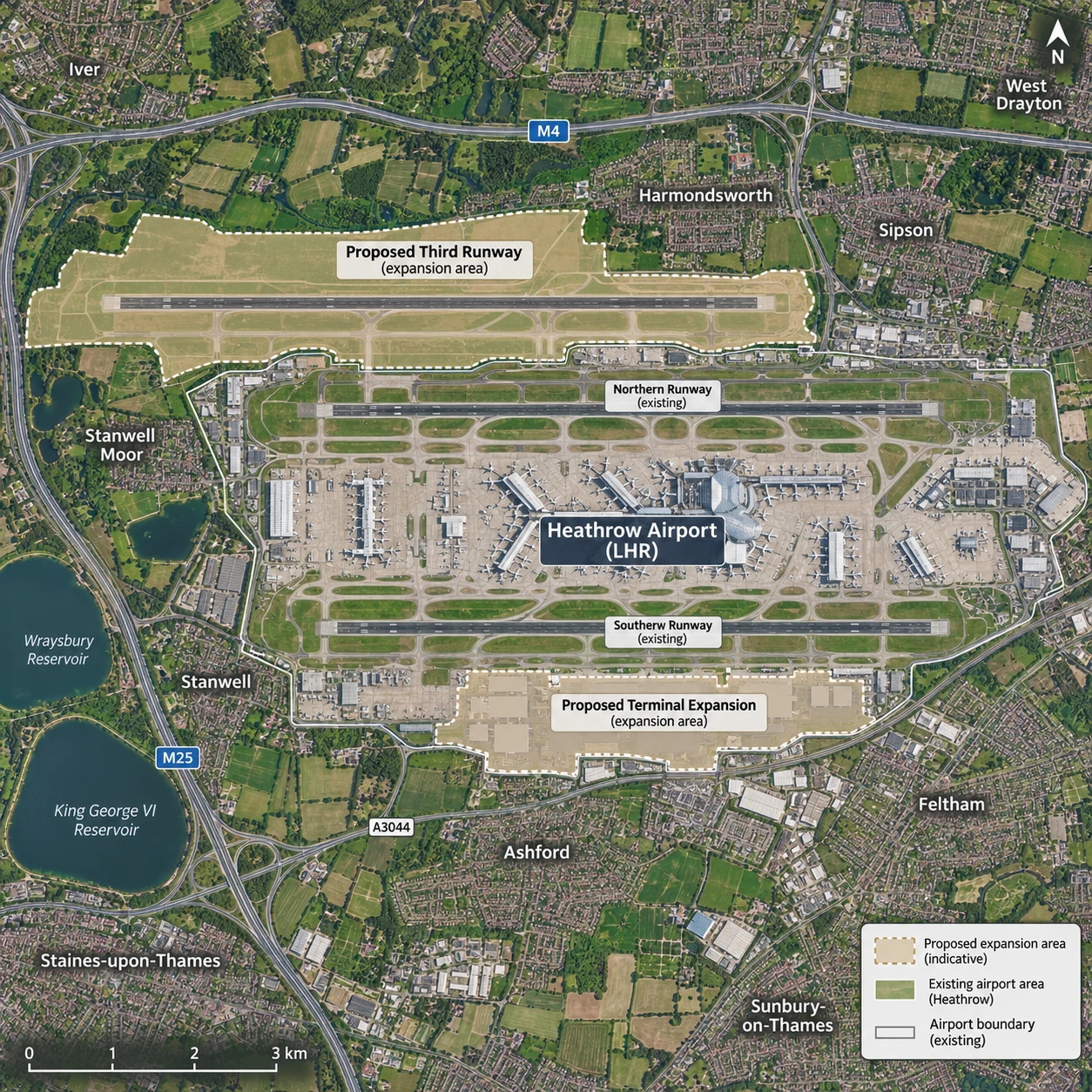
The Arora Group’s competing proposal has added a new option to the debate over Heathrow expansion. Its significance will depend on what the scheme contains, how it compares with Heathrow Airport Limited’s (HAL) plans, and whether either proposal can satisfy planning, environmental and community tests.
For people in Stanwell Moor, the discussion is practical as well as strategic. Any expansion could raise questions about aircraft noise, air quality, construction and the evidence used to assess local effects. At this stage, however, neither proposal should be treated as approved or certain to proceed.
Why a competing Heathrow proposal matters
A competing Heathrow proposal matters because it could broaden the choices considered in the expansion debate. The Arora Group’s scheme puts forward an alternative to HAL’s plans, but its presence alone does not establish that it is more deliverable or that it will be selected.
Large airport projects involve more than drawing a new runway or terminal on a map. The proposals may differ in their design, land requirements, operating assumptions, construction approach and effects on nearby places. Those details determine whether an alternative offers a meaningful change or mainly a different route to a similar outcome.
Competition can also sharpen scrutiny. HAL may need to explain why its preferred approach meets the airport’s objectives, while the Arora Group would need to show that its own scheme is technically feasible and can address planning and environmental constraints. Comparisons are only useful when they rely on consistent assumptions and enough detail to test them.
For local residents, the key question is not simply which developer’s plan sounds more attractive. It is whether the evidence shows how each option could affect homes, roads, aircraft operations and environmental conditions, and what measures could prevent or reduce harm. Those answers may emerge gradually as proposals develop.
How the Arora Group scheme compares with HAL’s plans
The main difference is that the Arora Group and Heathrow Airport Limited are presenting competing approaches to Heathrow expansion; neither should be described as an approved plan. A reliable comparison requires current, detailed information about each scheme rather than assumptions based on its sponsor or headline claims.
At a high level, readers can compare the proposals across a few practical dimensions:
- Design and footprint: What airport infrastructure is proposed, and how much land or existing development could be affected?
- Operations: What assumptions does each scheme make about aircraft movements, capacity and how the airport would function?
- Delivery: What construction stages, access arrangements and supporting infrastructure would be needed?
- Local effects: How would each option assess noise, air quality, traffic, land use and impacts on nearby communities such as Stanwell Moor?
- Mitigation: What measures are proposed to avoid, reduce or manage adverse effects, and how would their effectiveness be monitored?
These are comparison questions, not claims that either scheme has already resolved them. A proposal may offer advantages in one area while creating trade-offs elsewhere. For example, a different footprint could change which locations face construction disruption, but it would not by itself prove that aircraft noise or pollution would fall.
Readers should also distinguish a developer’s stated aims from evidence that has been independently tested. Until plans and supporting assessments are sufficiently developed, firm conclusions about cost, timing, capacity or community impact would be premature.
What the Planning Inspectorate pre-application process means
The Planning Inspectorate’s pre-application process is an early stage in preparing certain major infrastructure proposals for examination. It helps identify procedural requirements and issues that may need attention; it is not a final planning decision and does not mean a proposal has been approved.
For a project of this scale, the process can involve discussions about the information an application should include, consultation expectations and how environmental effects should be assessed. The Planning Inspectorate may provide advice on the application process, while the promoter remains responsible for developing the scheme and producing the supporting documents.
That distinction matters when news reports mention engagement with the Inspectorate. Pre-application contact is not the same as submitting a complete application, and submission is not the same as receiving consent. A proposal would still need to pass through the relevant examination and decision-making stages, with opportunities for issues and evidence to be considered under the applicable process.
People following the Arora Group and HAL proposals can use this stage to watch for concrete information: consultation materials, draft plans, environmental studies and explanations of how feedback will be considered. The process may help reveal what remains unresolved, but it cannot guarantee that a scheme will advance or secure approval. Details of the Inspectorate’s role are available on the Planning Inspectorate website.
Potential consequences for Stanwell Moor
For Stanwell Moor, the potential consequences of either Heathrow expansion proposal depend on the final design and airport operations, as well as the quality of the impact assessments. Noise and air quality are central questions, but the available information must be specific enough to show how residents could be affected.
Noise impacts could relate to aircraft routes, the timing and frequency of flights, changes in ground activity, and construction. Assessments should make clear which scenarios they model, what baseline they use and how results vary by location and time of day. A broad airport-wide average may not explain what residents near a particular route or site would experience.
Air quality assessments need to consider relevant sources of emissions and how pollution levels could change under different operating and traffic scenarios. The question is not only whether an airport’s overall emissions are discussed, but whether the analysis addresses exposure in affected communities and explains its assumptions. Construction traffic and changes to local roads may also need consideration.
Residents can look for practical detail in future documents:
- Maps showing proposed infrastructure, flight-path assumptions and assessment locations.
- Separate analysis of construction and long-term operational effects.
- Clear explanations of baseline conditions, modelling methods and uncertainty.
- Specific mitigation proposals, with information on who would deliver and monitor them.
- How community feedback, including concerns from Stanwell Moor, changes or informs the plans.
These materials may identify possible effects, not guarantee a particular outcome. Noise and air quality results depend on assumptions, and mitigation can reduce some impacts without removing them all. Until comparable assessments are available, it is too early to say which competing scheme would be better for Stanwell Moor.
What remains uncertain about Heathrow’s future
Heathrow’s future remains uncertain because neither competing proposal can be judged on its headline description alone. The next steps will depend on the detail of each scheme, environmental evidence, consultation and the outcome of the relevant planning process.
Several questions will help determine whether either proposal advances:
- What infrastructure and operational changes does each scheme actually propose?
- Can the promoters demonstrate that their plans are technically and practically deliverable?
- What do comparable assessments show about noise, air quality, traffic and land impacts?
- How will Stanwell Moor and other affected communities be consulted, and how will responses be addressed?
- What application and examination steps would follow, and which authority would make the relevant decisions?
The most useful developments to watch are published plans and consultation documents, followed by environmental assessments that explain their methods and limitations. Those sources can separate established information from early-stage claims and show where evidence is still incomplete.
For now, the Arora Group’s competing scheme changes the range of options under discussion. Whether it reshapes the outcome of Heathrow expansion will depend on how it stands up against HAL’s plans, planning requirements and the real-world consequences for nearby communities.
Frequently asked questions
Is the Arora Group proposal an approved Heathrow expansion plan?
No. It is a competing proposal, and the information described here does not establish that it has received approval or will proceed.
How does it differ from Heathrow Airport Limited’s scheme?
The proposals are competing approaches, but a dependable comparison requires detailed, current information about their design, operations, delivery, environmental effects and mitigation. Avoid treating unverified claims as settled differences.
What does the Planning Inspectorate do before an application is submitted?
Its pre-application process can provide procedural advice and help identify requirements for preparing a major infrastructure application. It is not an approval decision, and the promoter remains responsible for its proposal and supporting evidence.
What could the proposals mean for Stanwell Moor’s noise and air quality?
Potential effects would depend on the final designs, aircraft operations, construction and related traffic. Comparable local assessments are needed before drawing conclusions about noise or air quality in Stanwell Moor.